
Which fold suits your content?
The fold type decides in what order content appears as the piece is opened: a roll fold opens one panel at a time, an accordion fold unfolds as a strip, and a gatefold closes two wings toward a wide centre. A brief should give closed size, open size and artwork size with bleed separately.
Start with what readers should see as they unfold the sheet: one step at a time, a continuous overview or a wide centre panel. The examples below help you decide. They are editorial planning suggestions, not specifications for a particular print product.
Three folds, three ways to open
Each drawing shows a flat sheet and, below it, the edge of the partly folded paper. Dashed magenta lines mark the folds. The diagrams explain the principle; they are not dimensioned artwork templates.
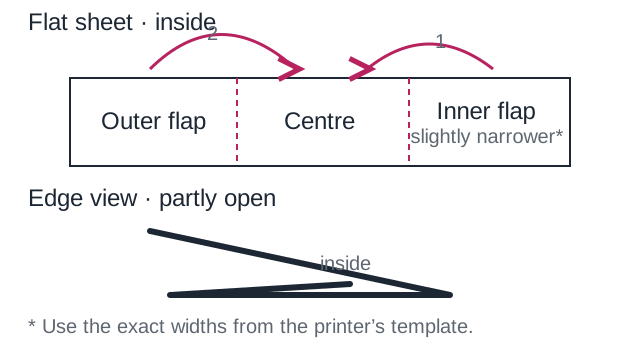
Roll fold: open one panel at a time
The parallel folds run in the same direction: one panel folds inside and the other closes over it. When opening the leaflet, the inner panel becomes accessible after the outer one. [1]
For your layout: Sketch the cover, the first opening and the fully open content as separate views. You could use the inner flap for extra details.
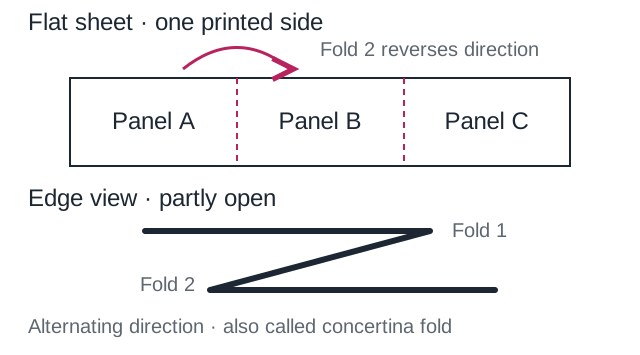
Accordion fold: unfold a strip
Also called a Z-fold or concertina fold: the direction alternates from fold to fold. Two folds create six pages; further parallel folds extend the sequence. [2]
For your layout: You could place three programme items side by side. Check both the overall view and each panel on its own.
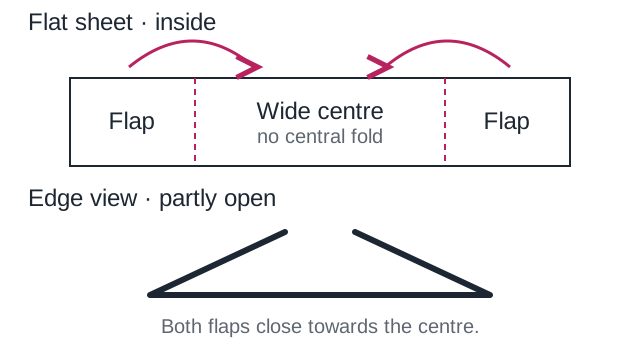
Gatefold: two flaps towards the centre
In an open gatefold, two narrow outer flaps close towards the wide centre without overlapping. This creates six printable faces of different widths. A closed gatefold adds a central fold, giving eight faces. [3]
For your layout: You could reserve the centre for a product drawing. Explicitly specify the open or closed version in your brief.
Choose a fold to suit the content
This planning aid follows from the opening sequences shown above. Try your preferred option with a labelled paper mock-up.
| Your task | Starting point | Check on the mock-up |
|---|---|---|
| Product overview with introduction and details | Roll fold: introduction at the first opening, details inside. | Does the content still make sense when only one flap is open? |
| Invitation with a reply section | Test a roll fold or accordion fold as a mock-up first. Plan the reply section as a separate panel. | Will the date and address remain after detachment? Agree the perforation position and suitability for writing separately. |
| Event leaflet with a schedule | Accordion fold: time slots side by side. For a large central image, compare an open gatefold. | Is it easy to find your way both when closed and in the open overview? |
A reply section is a separate requirement. Specify its size, wording and intended detachability in the brief; choosing a fold alone does not define these properties.
Flat, folded and including bleed
Keep three dimensions distinct in your brief: the folded size after folding, the flat size of the unfolded, trimmed sheet and the artwork size including bleed. Panels that fold inside are not automatically equal in width. [4]
A specific specification sheet: roll fold
- Folded
- 99 × 210 mm
- Flat, excluding bleed
- 295 × 210 mm
- artwork size
- 299 × 214 mm
In the linked SAXOPRINT specification, the inner flap is 2 mm narrower: 99 + 99 + 97 = 295 mm. Bleed is 2 mm on each outer edge. These are product requirements for this example; use your chosen printer’s dimensions for your own order. [4]
Write out width × height in millimetres, even if you also use a format name. “Open gatefold” names the fold variant; “flat size” here means the fully unfolded sheet.
Before approval: artwork and finishing
- Check reading direction on a mock-up. Fold a blank sheet, mark the cover, the back and the top edge of each panel. Open it again and transfer the arrangement to your layout. This also helps you check rotated content. [5]
- Use the specific artwork template. Follow panel widths, bleed and safety margins. Check whether marks are wanted in the file: for its main shop, FLYERALARM requires files without fold or crop marks, for example. [6]
- Agree paper and folding together. Grain direction describes the alignment of paper fibres; cracking at the fold remains possible even when grain direction is considered. Ask the printer about the intended stock, possible creasing and a folded sample. [7]
- Record the delivery condition. State whether you need ready-folded copies. If a reply section is included, cover the agreed perforation in the same approval.
For material planning, see the guide to paper grammage. For a mailing, calculate paper weight using the dimensions of the entire sheet, rather than a single folded panel.
Sources and context
Fact-checked on 28 September 2026. Manufacturer information supports the processes or products cited, not a general supply commitment by Mailingbid. The text, planning aid and drawings are original; no third-party illustrations were reproduced.
- FLYERALARM: leaflet fold types (German) — fold direction and opening sequence of a roll fold.
- SAXOPRINT: accordion fold (German) — alternating fold direction, concertina folds and page count.
- SAXOPRINT: open and closed gatefold (German) — flaps, central fold and printable faces.
- SAXOPRINT: roll-fold leaflet specification (German PDF) — 99 × 210 mm product example, panel widths and bleed.
- Onlineprinters: reading direction (German) — orientation and a labelled folding mock-up.
- FLYERALARM: artwork size and bleed (German) — specification sheets, safety margins and printer’s marks.
- Onlineprinters: grain direction (German) — fibre orientation and possible cracking at the fold.