
Self-mailer, letter or postcard: which suits your mailing?
The right format depends on the content: a self-mailer is sent without an envelope, a letter in an envelope combines a covering letter with separate inserts, and a postcard carries a short message on one card. Personalisation and postal product belong in the brief as well.
Start with the content: do you need a separate form, will a short invitation do, or should a voucher appear as the piece unfolds? Compare the constructions here and use a suitable composition as the starting point for your request.
What is a self-mailer?
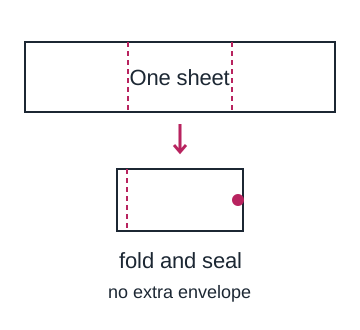
A self-mailer is a mail piece where content and wrapping are one: a single sheet of paper is folded and closed, for example with glue spots or sealing labels, into a ready-to-post item. Deutsche Post therefore also calls it a folded letter item (Faltbriefsendung); Österreichische Post lists it as an item without an envelope. [8] [9]
The address goes on the outside of the sheet and no envelope is needed. Whether a given design can be machine-processed then depends on format, paper weight and closure; the limits of the Austrian and German postal operators follow further down.
Construction shapes the plan
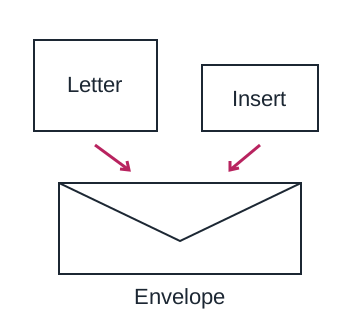
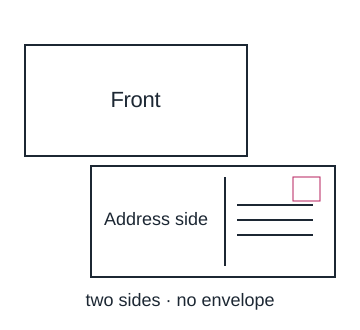
A self-mailer is sent without an additional envelope and can be sealed with glue or closure labels, for example. It can include integrated reply sections. [1] An enveloped mailing combines a covering letter with separate items such as a leaflet or reply card. [2] A conventional postcard needs no envelope and can also be personalised. [3]
Self-mailer
Letter in an envelope
Postcard
| Planning question | Self-mailer [1] | Letter in an envelope [2] | Postcard [3] |
|---|---|---|---|
| Space and content | Arrange content across folded panels; define the opening sequence. | Plan the letter and further sheets as separate items. | Plan a short message on two sides; allow space for the address. |
| Personalisation | Specify the address outside and any variable content inside. | Address and salutation in the letter; agree matching of personalised inserts. | Specify the address side and other variable text fields. |
| Inserts | Agree the construction of an integrated reply section or further elements. | List each insert with its size, material and quantity per mailing. | Do not plan a loose insert in the postcard example considered here. |
| Finishing | Check folding, sealing and opening on a sample. | Agree folding, collation and enveloping. | Plan trimming and addressing; no enveloping in the postcard example. |
| Decision question | Does the intended reading sequence work on a folded product? | Do recipients need several independent items? | Is the message complete on a single card? |
All three constructions offer personalisation options. Specify which fields should vary in the brief, alongside the format choice. The production examples linked above demonstrate these possibilities, not the availability of every version from every supplier.
Format limits for machine processing in Austria and Germany
As of 23 October 2026; the current terms of the postal operator are authoritative. The table gives the values for self-mailers in each operator's standard advertising mail format; larger formats have their own values. We do not list values for the Czech Republic or Slovakia here.
| Feature | Austria: Info.Mail Werbung [9] [10] | Germany: Dialogpost [8] [4] |
|---|---|---|
| Standard format | Info.Mail Werbung Classic: 140 × 90 to 235 × 162 mm, up to 5 mm thick, up to 50 g; machine processability is mandatory. | Dialogpost Standard: length 150 to 235 mm, width 90 to 125 mm, up to 5 mm thick, up to 50 g; the length must be at least 1.4 times the width. |
| Larger format | Info.Mail Werbung Plus: up to 324 × 229 × 24 mm, up to 2,000 g; bundling required. | Dialogpost Groß (large): length 140 to 353 mm, width 90 to 250 mm, up to 30 mm thick, up to 1,000 g. |
| Minimum paper weight | Closed edges: 100 gsm with a single fold, 70 gsm with more than one fold. Open edges: 135 to 200 gsm depending on format and folds. | Four pages, one piece: up to C6 at least 150 gsm, up to DL 170 gsm, larger 200 gsm. Six pages or more, such as a roll fold: at least 115 gsm. |
| Closure | Bottom edge folded or glued along its full length. The flap needs at least two glue lines or glue spots, or two tear-open sealing labels, three for formats above B6, no more than 5 mm from the edge. No staples. | Both long sides, or the bottom long side and both short sides, closed along the full length, plus the closing flap. Adhesive tabs on the outside are not possible on the bottom long side. Above 20 g the right short side generally has to be closed. |
| Perforation | Ratio 2 : 1 (two parts web, one part slit), at least 15 mm from the bottom edge. | Top or left only. The guideline calls 1 : 3 proven (for example 1 mm cut to 3 mm web). |
The perforation ratios contradict each other: Österreichische Post requires two parts web to one part slit, Deutsche Post recommends one part cut to three parts web. Each applies in its own country only. A self-mailer for both markets therefore needs separate approvals, or you avoid perforation.
Specify print format and postal service separately
For German DIALOGPOST, Deutsche Post identifies three areas of machine compatibility: address readability, address-side layout and physical characteristics. Suitable paper weight alone is therefore not full approval for mailing. [4] The online layout check examines the first two areas; it explicitly does not assess physical characteristics. [5]
In Austria, commercial advertising such as offers and vouchers may qualify for Info.Mail Werbung. The postal service sets requirements for the sender, basic mailing, size and weight, and excludes certain content. [6] For donation appeals, assess Sponsoring.Mail separately: eligibility depends on the organisation and content, among other things, and an admission agreement is required. Mailings on behalf of commercial companies are excluded. [7]
Our planning suggestion: agree a complete sample with every component, closure and intended addressing first. Then have weight, thickness, finishing and postal service confirmed together. Check each version with a promotional item separately.
Use the paper weight calculator for an initial estimate and the paper grammage guide for material selection. To plan a self-mailer, compare the fold types.
Three complete sample briefs
All quantities, constructions and scenarios are invented planning examples. They are not approved production specifications. Outstanding details are explicitly identified and must be completed before ordering.
Win back customers with a voucher
Self-mailer for feasibility assessment
Our example decision: the offer, redemption terms and voucher each get a section on the same sheet. No separate covering letter is planned.
- Client and purpose
- Company; 5,000 mailings to Germany. Invite existing customers to make another purchase.
- Size and extent
- Draft: six pages, folded size 210 × 100 mm; agree flat size, panel widths and closure using the production template.
- Content and response
- Offer on the cover, terms inside, voucher with an individual code; redeemable in our own shop. No separate insert.
- Stock and printing
- Full colour on both sides; ask for paper type and grammage proposals after testing folding and closure. No special finishes planned.
- Personalisation
- Address, salutation and voucher code. Client supplies the data; approve a sample using test data.
- Finishing and mailing
- Printing, personalisation, folding, sealing and postal handover in Germany. Check DIALOGPOST suitability and the complete physical construction beforehand.
- Weight and timing
- Assess weight and thickness on a sealed sample. Preferred postal handover date is open; supplier to propose a production and approval schedule.
- Approval and quotation
- Approve artwork, personalisation and physical sample. Quote production, mailing services and postage separately; confirm feasibility.
The request form has no dedicated self-mailer category. We transfer it as “Other” with this brief for a feasibility assessment. This is an enquiry, not a production commitment.
Enquire about self-mailer feasibilityInvitation with a short registration step
Postcard
Our example decision: the date, location, programme summary and registration address fit on one card. Neither a reply envelope nor a separate programme is needed.
- Client and purpose
- Company; 2,000 invitations to a product presentation in Austria.
- Size and extent
- Draft: A6 landscape, 148 × 105 mm, two printed sides; no folding.
- Content and response
- Event, place and date on the front; short programme summary and registration web address on the back. No inserts.
- Stock and printing
- Full colour on both sides; supplier to propose card stock suitable for postal use. No special finishes planned.
- Personalisation
- Name and postal address on the address side; otherwise identical content. Client supplies address data; approve a test record.
- Finishing and mailing
- Printing, addressing and postal handover in Austria. Check classification as Info.Mail Werbung and address layout before production.
- Weight and timing
- Determine finished copy weight after selecting the paper. Add event date and preferred postal handover date before ordering.
- Approval and quotation
- Approve design and personalised sample. Quote production, mailing services and postage separately; confirm timing.
Donation appeal with a payment slip
Letter in an envelope
Our example decision: the letter and payment slip remain separate components. An extra item can be described as a separate quotation variant.
- Client and purpose
- Non-profit organisation; 10,000 mailings in Austria. Explain a donation project and enable bank transfers.
- Size and extent
- A4 letter, two printed sides, folded to fit the envelope; C6/5 window envelope; one separate Austrian SEPA payment slip to the applicable standard.
- Content and response
- Project description and appeal; transfer using the payment slip. Confirm account and reference details before production.
- Stock and printing
- Letter in full colour on both sides, paper type and grammage open; envelope printed in one colour. Payment slip to the applicable form standard.
- Personalisation
- Address and salutation in the letter; agree matching with references on the payment slip. Client supplies addresses; test-data approval.
- Finishing and mailing
- Printing, personalisation, folding, collation, enveloping and postal handover in Austria. Sponsoring.Mail only after checking sender, content and admission agreement; otherwise propose an alternative.
- Weight and timing
- Weigh the complete mailing including envelope, payment slip and any extra item; check thickness and machine compatibility. Preferred postal handover date open.
- Approval and quotation
- Approve artwork, matching of personalised components and filled sample. Quote production, mailing services and postage separately; confirm eligibility and timing.
Current composition: envelope, letter and payment slip, without an additional promotional item.
Use the donation appeal briefThe links transfer components, example country, example quantity and brief into a request that has not yet been submitted. Review and edit the details there. Dimensions, stock and finishing initially appear in the brief; add the structured details after the first step.
Sources and context
Researched on 28 September 2026. These primary sources document constructions and postal requirements. The text and sample briefs are original; no third-party images or templates were reproduced. We infer no increase in response or donations from the format choice. Sources 8 to 10 on format limits were checked on 23 October 2026.
- Deutsche Post E-POST Solutions: self-mailers (German) — construction, sealing, integrated elements and personalisation.
- Deutsche Post E-POST Solutions: enveloped mailings (German) — components and finishing.
- Deutsche Post E-POST Solutions: postcards (German) — card construction and personalisation.
- Deutsche Post: DIALOGPOST (German) — machine compatibility requirements.
- Deutsche Post: layout check (German) — scope of checking and exclusion of physical characteristics.
- Österreichische Post: Info.Mail Werbung (German) — content and requirements for commercial advertising mail.
- Österreichische Post: Sponsoring.Mail (German) — eligible senders, content and admission agreement.
- Deutsche Post: Automationsfähige Briefsendungen (guideline, as of January 2026) — definition of a self-mailer, minimum paper weight and closure in section 4.3, checked 23 October 2026. In German.
- Österreichische Post: Voraussetzungen für die Maschinenfähigkeit (valid from 1 April 2020) — closure, perforation and minimum weight of items without an envelope in section 2.6, checked 23 October 2026. In German.
- Österreichische Post: Produkt- und Preisverzeichnis Info.Mail Werbung (valid from 1 January 2026) — formats and weights of Classic and Plus, checked 23 October 2026. We deliberately list no prices. In German.